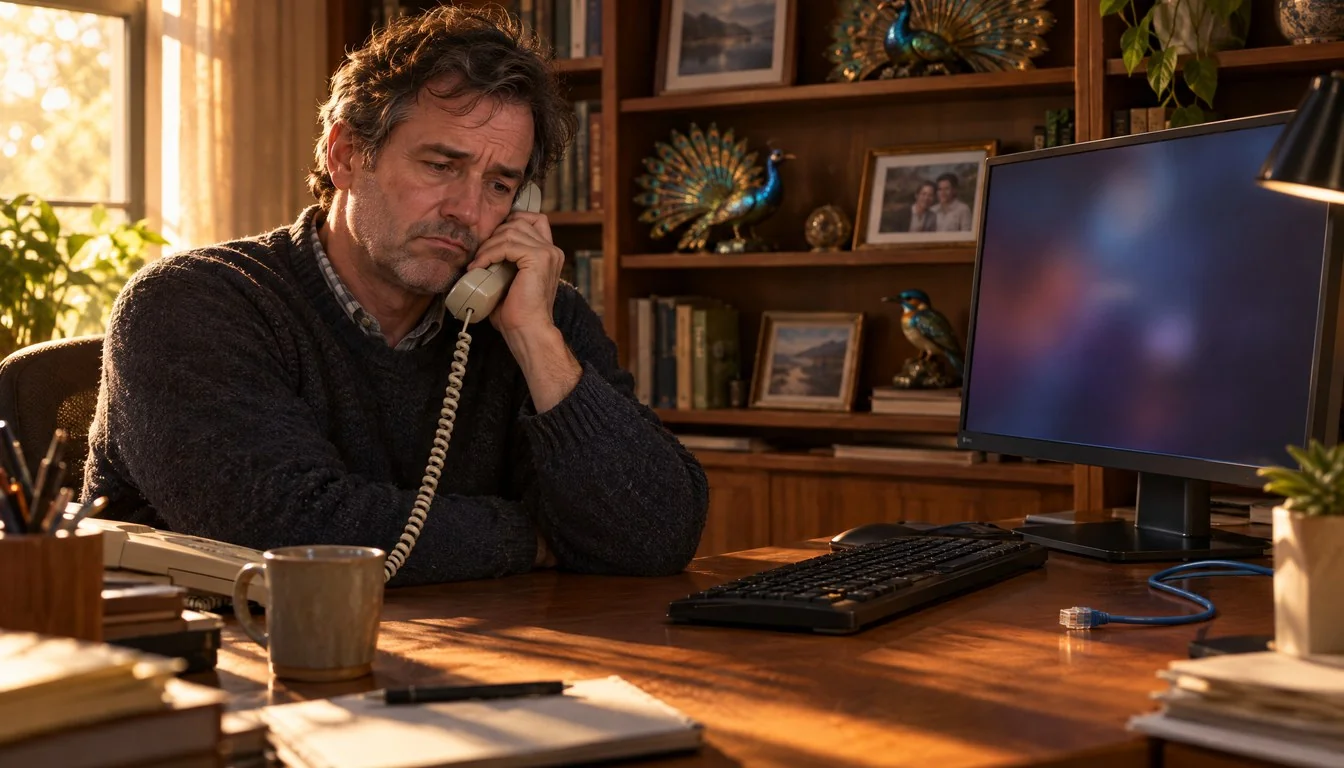
"Mom, can I use your phone to search it up?"
That's my tween talking, and "it" could be anything.
NeeDoh's Halloween drop. Where The Inbestigators cast is today? Pranks for a sleeping person that are kid-friendly. The Haaland song. And, very specifically, "I have braces and my back tooth with the bracket hurts and I leave for camp in three hours."
But what's interesting isn't what my daughter is looking for. It's how she talks about getting information.
I am never asked, "Can I Google it?" That's adult lingo. Kidspeak is increasingly "search it up" — fitting for a generation whose searches aren't limited to one place.
A recent New York Times Magazine piece highlighted this generational divide, reporting that Gen Alpha and Gen Z increasingly say "search it up," whereas older generations might say "Google it."
Ryan L. Boyd, a psychologist and computational social scientist at Vanderbilt University, puts the distinction simply: "'Google it' tells you where to go. 'Search it up' tells you what to do."
For kids today, there's no single "where."
Unlike "that's AI," which is also Gen Alpha lingo, "search it up" isn't new.
The radio show A Way With Words dove into it in 2018, noting there had been "uses found from around 2005 and probably earlier."
The New York Times Magazine piece goes deeper, noting that the Oxford English Dictionary traces "search up" back to the 1500s. The phrase itself sounds like a mashup of eras; it combines the familiar "look it up" with the modern act of "searching."
What's notable is how well the phrase now fits the way younger people find information.
When Google became the dominant search engine in the early 2000s, "Google it" came to describe the whole process. You went to Google, typed a query in the search bar, sifted through results, clicked around and eventually found an answer. "Google" became a verb, with Merriam-Webster adding it to its dictionary in 2006.
For Gen Alpha, there are more places to find answers. A kid may ask ChatGPT or Claude, Siri or Alexa. They may search it up on TikTok or YouTube, or turn to a traditional search engine.
"Google it" doesn't cover all the possibilities.
Take the Erling Haaland song. My daughter wanted it as her victory song after dominating a heated family card game.
Google wasn't the obvious place to start. YouTube has the full song, so it makes sense to go there first. TikTok could show her how other people are talking about and using the tune. Or she could ask an AI chatbot about it. "Search it up" works across all of them.
That range of options reflects how kids spend their time online. According to a 2025 Pew Research Center survey, 85% of parents of children 12 or younger said their child watches YouTube, including 51% who watch it daily. Among parents of 11- and 12-year-olds, 37% said their child uses TikTok.
That expands as kids get older. Nine in 10 teens use YouTube, and roughly six in 10 use TikTok, according to other Pew data. And AI chatbots have become another place to look for answers: In a 2026 Pew report, 57% of teens said they had used chatbots to search for information.
The change to "search it up" isn't a conscious generational decision.
"To my knowledge, young people didn't sit down in a big meeting and decide that Google was over," Boyd says. "It's more that 'where you go for answers' used to have one obvious answer, and now it's much more context-dependent."
And a small change in vocabulary can tell us something bigger.
Boyd says the words themselves are "the least interesting part" of this evolution. They're an indication that people's day-to-day behavior, experiences and even thought processes are changing.
So "Google it" is out, "search it up" is in. Needing Mom's phone to do it? Well, that hasn't gone out of style — yet.
We're back with another Yahoo Fantasy Football Instant Mock Draft, this time out of the No. 2 pick. Check out the full recap.
ZZ Top drummer Frank Beard has died at 77 after 56 years with the Texas rock band, which plans to continue touring.
Big funds are clinging to Google.
"I'm glad that we're fiery, I love the competition out here," offensive coordinator Davis Webb said. But "we can't cross that line, and that's offense and defense."
There are numerous injuries affecting NFL teams less than a month before the regular season.
Nate Tice & Matt Harmon deep dive on all four teams in the AFC South ahead of the 2026 NFL season.
After 15 years on the sport's biggest stage, UFC's Edson Barboza showed us the quiet heroics behind terms like "journeyman" or "gatekeeper."
Edwards appeared in two games in 2025 thanks to a Week 1 knee injury.
Behold the All-Breakouts team of 2026 for college fantasy football.
Pledges were often made to cut and package cocaine as part of their indoctrinations, authorities say.
'Google it' is out. Gen Alpha would rather 'search it up.' – Yahoo Lifestyle Canada